Western Pacific Annual Reports
 1947 -- Up to this point, WP's Annual Reports were, well, boring. Plain grey covers, no
pictures inside, nothing but the bare essentials. Then, in 1947, the first of the new CZ equipment
arrived, and with it a new era in the Annuals. The 1947 edition still had the plain grey cover, but
for the first time it included a photograph inside. The caption for this shot is: "The first of the
California Zephyr Diesel locomotives arrived in Oakland July 10, 1947, bringing in the Exposition
Flyer. The sides are of gleaming stainless steel with the front end and side color bands painted
brilliant orange." (From the collection of the Northwestern University Transportation Library)
1947 -- Up to this point, WP's Annual Reports were, well, boring. Plain grey covers, no
pictures inside, nothing but the bare essentials. Then, in 1947, the first of the new CZ equipment
arrived, and with it a new era in the Annuals. The 1947 edition still had the plain grey cover, but
for the first time it included a photograph inside. The caption for this shot is: "The first of the
California Zephyr Diesel locomotives arrived in Oakland July 10, 1947, bringing in the Exposition
Flyer. The sides are of gleaming stainless steel with the front end and side color bands painted
brilliant orange." (From the collection of the Northwestern University Transportation Library)
 1949 -- With the inauguration of the California Zephyr service, the WP's annuals suddenly
become colorful. This artwork was done for Standard Oil to commemorate the inauguration of
the Zephyr. (From the collection of the Northwestern University Transportation Library)
1949 -- With the inauguration of the California Zephyr service, the WP's annuals suddenly
become colorful. This artwork was done for Standard Oil to commemorate the inauguration of
the Zephyr. (From the collection of the Northwestern University Transportation Library)
 1950 -- A colorized black-and-white photograph of a scene of "Two freights passing
under CTC at Keddie, Calif." A careful look will reveal a discrepancy with the General
Motors/EMC model FT locomotives....by the small black strip crossing the nose, these are
painted in the all-orange "Pumpkin I" scheme...however, the touch-up artist painted these in the
later silver-and-orange stripe scheme! (From the collection of the Northwestern University
Transportation Library)
1950 -- A colorized black-and-white photograph of a scene of "Two freights passing
under CTC at Keddie, Calif." A careful look will reveal a discrepancy with the General
Motors/EMC model FT locomotives....by the small black strip crossing the nose, these are
painted in the all-orange "Pumpkin I" scheme...however, the touch-up artist painted these in the
later silver-and-orange stripe scheme! (From the collection of the Northwestern University
Transportation Library)
 1956 -- The classic WP promotional photo of the California Zephyr crossing the Clio
Viaduct in winter. No caption or photographer info provided.
1956 -- The classic WP promotional photo of the California Zephyr crossing the Clio
Viaduct in winter. No caption or photographer info provided.
- Photos from the Annual Report
- Graphic of the WP tug Humaconna.
- Keddie: "Freight for Southern California over the Inside Gateway pulls into Keddie as
the eastbound California Zephyr departs."
- Wide Load: "Western Pacific's ample clearances make it the ideal route for 'high-wide'
shipments."
- "New passenger ticket office in Western Pacific Building, San Francisco."
- "New rail welding plant at Winnemucca."
- Field Trip: "One of more than a hundred youth groups introduced to modern train travel
on the California Zephyr during 1956."
- "Exhibit of new Western Pacific rolling stock at San Jose."
- From the Front Office: A disappointing year: Gross revenues were down slightly from 1955 at
$53.5 million and net income was down a whopping 21% from the previous year. Part of this
was due to the unprecedented storms that hit WP's territory in the opening weeks of the year,
causing wide-spread damage, including the need to bypass a particularly slide-prone section of
the Canyon with the new Tunnel 15. CZ revenues were up to $2.99 million.
- Around the System:
- A new train ferry for the San Francisco bay was designed and ordered from the Albina
Engine & Machine Works of Portland OR. The new 375-foot diesel-powered ferry will
be able to carry 27 freight cars, and will replace two 14-car wooden carfloats and two
steam tugs.
- 350 new freight cars, including 150 special purpose units were purchased. One steam
switching locomotive, ten heavyweight passenger cars and 424 "over-age" freight cars
were retired.
- Freight traffic declined, as much of the canned goods normally carried went into
temporary storage instead of being moved east, and a nationwide cutback in new home
construction reduced lumber and construction materials traffic. However, bituminous
coal shipments for export were up substantially, as were Barytes and other Nevada and
Utah mine products. Steel shippments dropped due to a strike during all of July and part
of August. Production and sales of automobiles were down nationally, which also
contributed to the decline in traffic.
- The CZ experienced a schedule change due to ferry boat schedules, with a San
Francisco departure moving from 10 am to 9:25 am, with no change in Salt Lake City
arrival times. Six of the CZ's sleepers were pulled from service for a thorough
re-shopping at Pullman, due back in April of 1957.
- Ten bridges were eliminated and three wooden trestles were replaced with concrete
structures.
- Employment levels held steady, at 4,529.
- Celebrations were held to commemorate the 50th anniversary of driving the WP's first
spike.
 1957 -- The Western Pacific Train Ferry Las Plumas made its debut in '57, and fittingly
graced the cover of this year's Annual. No caption or photo credit were given for the cover shot.
1957 -- The Western Pacific Train Ferry Las Plumas made its debut in '57, and fittingly
graced the cover of this year's Annual. No caption or photo credit were given for the cover shot.
- Photos from the Annual Report
- "The Las Plumas is welcomed to San Francisco Bay by geyser-spraying fireboats, the
"Golden Fleet" of Bay yachts, and the old WP tug Humaconna."
- Christening: "Mrs. F. B. Whitman [wife of WP's President] smashes a traditional bottle
of California champagne against the new train ferry Las Plumas at Portland, Oregon."
- The Missing Pallet: "Demonstration of Western Pacific-developed 'Unitized Shipments'
at Los Angeles Perfect Shipping Week Exposition". A copy of the advertisement on the
easel and which ran in several nation-wide magazines is included in the centerfold of the
Annual. The WP's research department received national recogintion by the canning
industry as a result of developing this packaging method, with canners as far away as
Hawaii adopting the unitized shipment techniques.
- "Executive Decision at Bear Creek", a California Zephyr ad also in the centerfold. In
1957, the Advertising department won several national awards for originality.
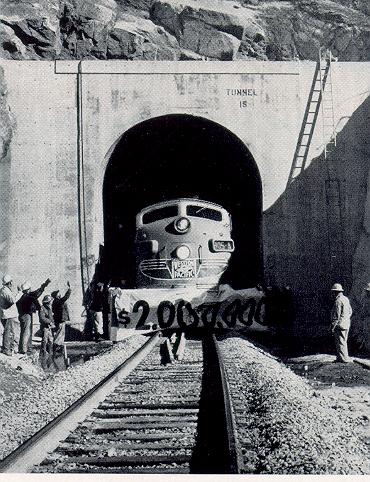
- New Tunnel: "The westbound California Zephyr on January 30, 1957, was the first
official train through new Tunnel 15 [3,100 feet], built at a cost of $2 million."
- Ribbon Rail: "Four 1,560-foot rails, welded from 39-foot lengths at the WP
Winnemucca rail welding plant, en route aboard 30 flatcars to be laid in Tunnel 15."
- "Driving of the 'Last Spike' completing the Union Street connection, March 1, 1957."
- From the Front Office: 1957 was looking like a great year, for the first three quarters, but then
a nation-wide business slump kicked in after Labor Day. Thus the $54.5 million gross revenue
represented only a 1.76% increase over the previous hear. However, due to many cost
reductions, net income rose 20% to $4.36 million. CZ revenues rose to $2.7 million.
- Around the System:
- The new car ferry, the Las Plumas, costing $1.3 million, begins service on July 28.
- Over 450 new freight cars were added. Two steam locomotives, five passenger cars and
260 freight cars were retired.
- Employment was down to 4,227.
- Operations of 19 special trains handling almost 10,000 children, "as well as almost a
hundred children's groups aboard the California Zephyr. We make a special effort to
familiarize children with the Railroad as they are the shippers, passengers and voters of
the future."
- The new 3,100 foot Tunnel 15 opened on January 25th with a price tag of $2 million.
The unprecedented storms at the end of 1955 and beginning of 1956 caused repeated
slides at milepost 250, leading to the decision to bore. The tunnels value was
demonstrated during a storm only a few weeks after the opening, when a large slide
came down and covered what was formerly the WP's main line at that point, "with our
new line being safe in the tunnel and traffic uninterrupted."
 1958 -- Cover depicts the Yardmaster's Tower, Stockton CA, which was built that year.
No caption or photo credit were given.
1958 -- Cover depicts the Yardmaster's Tower, Stockton CA, which was built that year.
No caption or photo credit were given.
- Photos from the Annual Report:
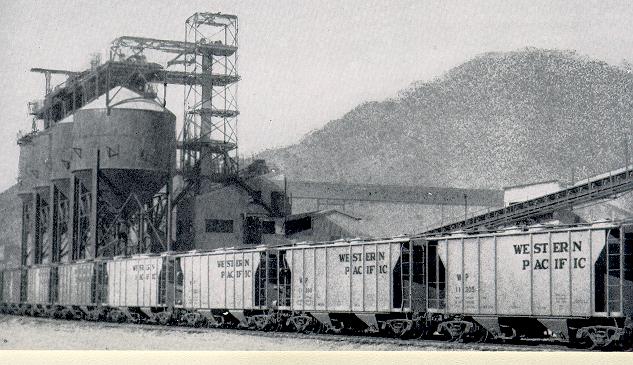
- Dolomite Hoppers: "A five mile spur track was laid from the main line to the new
dolomite plant of the Utah Marblehead Lime Company near Delle. Photo shows
covered hopper cars being loaded from storage bins."
- The Zephyrettes: "Western Pacific's two Budd RDC Cars make a night running meet in
the Feather River Canyon as each car chalks up a million miles of service."
- New passenger depot and division offices at Elko, Nevada.
- Icing machine: "New $40,000 Preco Mechanical car icing machine installed at Stockton
Icing Station."
- Drop-end Mill Gondola: "Gondola equipped with upper portion and cover at
Sacramento Shops. Cover is in three sections and may be stacked when lifted."
- 10th Annual Shrine Circus Train: "Beginning back in 1949 our Annual Circus Train has
carried over a thousand happy Nevada children each year to the Shrine Circus in Reno."
- CZ dome view.
- From the Front Office: The on-going recession, and the corresponding drop in national
business levels resulted in a $2.5 million drop in gross revenues to $52 million. However, net
income was 17 1/2% higher than in 1957. At year's end, the Traffic Department was
transformed into the Marketing Department, a change that reflected a new emphasis on selling
the services of the Railroad. And, despite the recession, the Zephyr's revenues were up
$27,000 to $2.7 million.
- Around the System:
- The WP participated in "Wide, Wide World", a coast-to-coast television special on
railroading.
- Celebrations of the new ferry Las Plumas continued into 1958 with short sightseeing
and hospitality cruises for special groups on San Francisco Bay.
- 119 new freight cars were added to the fleet, 75 drop end gondolas, 40 70-ton covered
hoppers, and four 70-ton Airslide hoppers. Four conventional dining cars as well as 172
freight cars and 54 MOW units were retired.
- Automobile and auto parts shipments were down sharply. Canned foods, corn and milo
maize, paper products, and lumber and building supply shipments were up.
- "A tradition of long standing came to an end.... Since the inception of passenger service,
WP passengers have traveled the 3 ½ miles across San Francisco Bay by ferry; first on
its own equipment between the WP Mole and the Ferry Building station, and since
1933, on Southern Pacific ferry boats.... On July 28, 1958, SP withdrew the last of its
ferry boats from service. Since that date, WP passengers to or from the Zephyr have
been carried by bus...via the Bay Bridge. The service is performed under contract by
Greyhound Lines. Such service is less picturesque -- although faster -- than the old trip
by ferry."
 1959 -- Cover: "The Truck Route That Isn't On Your Road Map", photo by Lionel
Bridge.
1959 -- Cover: "The Truck Route That Isn't On Your Road Map", photo by Lionel
Bridge.
- Photos from the Annual Report
- Army Jeeps "Cost-saving method of loading 15 Jeeps crosswise on one flatcar devised
by Western Pacific transportation engineers in cooperation with Army Ordinance."
- Piggy-Backs: "The 'TOF' eastbound piggyback freight passes through Portola with
trainload of highway trailers."
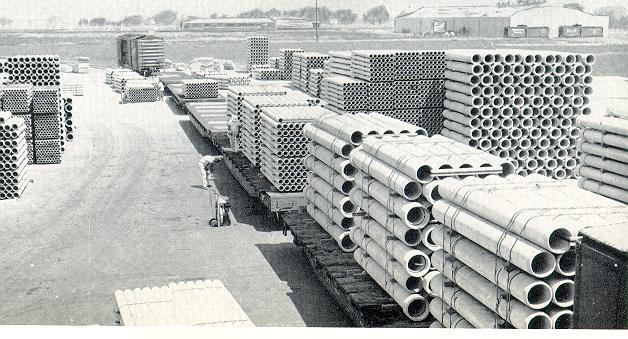
- Pipe Loads "Making up a trainload of Transite pipe for a special movement from the
Johns-Manville plant in the WP Industrial Tract at Stockton."
- Dockside: "WP switcher brings cargo for Formosa to the Nationalist China ship Union
Enterprise at Port of Stockton."
- Keddie in the Winter "Orders for an eastbound freight (left) at Keddie. In the center the
California Zephyr is passing, and at the right a northbound freight is about to start for
Bieber."
- Evening in Portola "In late afternoon, the eastbound California Zephyr stops at
Portola."
- Winterscape: An FT leads a freight across Nevada.
- From the Front Office: President Fred Whitman writes that the leadership is "disappointed"
that gross revenues are only up slightly over 1958. While the Company had a good first half,
the second half was seriously affected by the prolonged steel, non-ferrous metals and lumber
strikes across the nation. The gross was $52.9 million, up 1.6%. Because of a rise in expenses,
the net income dropped 20% over the previous year. The CZ grossed $2.7 million.
- Around the System:
- Thirty-three new industries were established along WP's lines.
- Piggyback operations expanded greatly, with 5,300 carloads as compared to only 750
the year before. Autos and parts shipments grew 30%, despite the strike. All other
commodities were stagnant or dropped off.
- On July 8, 1959, the transfer points for San Francisco-bound CZ passengers moved
from the 3rd and Washington Street WP station and the Ferry building to a new facility
at the Oakland coach yard (Middle Harbor Rd) and SP's 3rd and Townsend Street
station.
- Three tunnels were concrete lined, seven timber open-deck bridges replaced or refitted,
and a new 100 foot prestressed concrete bridge was built in Stockton one of the first of
its kind in the country.
- Six new 2,000 HP diesels and 200 freight cars were added to the fleet, with two
passenger cars, 182 freight cars and 47 MOW units retired.
- Number of employees dropped to 3,797.
- Three special "Cinerama" trains were operated, as well as the 11th annual Circus train.
- The CZ buffet lounge cars were refitted to the new San Francisco Cable Car Room
motif.
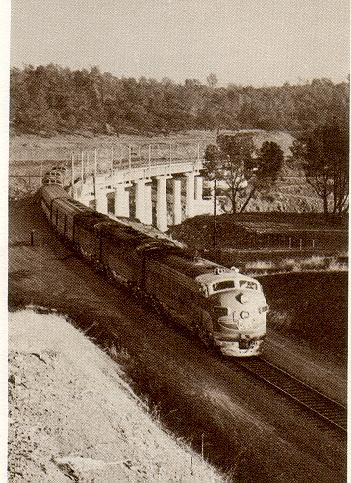
 1960 -- The California Zephyr skirts the Feather River. (From the collection of the
Northwestern University Transportation Library)
1960 -- The California Zephyr skirts the Feather River. (From the collection of the
Northwestern University Transportation Library)
- From the Front Office: On October 12th, the Southern Pacific announced that it had acquired
10% of the outstanding shares of WP stock and intended to acquire control of the company.
On October 25th, with the cooperation of WP management, the Santa Fe announced that it had
bought 20% of WP's stock and was intending to acquire control in opposition of SP. The
"Control Case" was then launched before the ICC.
- Around the system:
- Trains 1 and 2, the Budd RDC Zephyrettes were discontinued on October 1.
- 4,498 passengers were carried to the National Youth Congress and the Boy Scouts'
Jamboree.
 1961 -- Cover caption from the report: "The Golden Gate Merchandiser, a Western
Pacific "red ball" freight with various commodities for eastern markets, swings through Redmond
Cut in Altamont Pass. Photo by Lee Sherwood."
1961 -- Cover caption from the report: "The Golden Gate Merchandiser, a Western
Pacific "red ball" freight with various commodities for eastern markets, swings through Redmond
Cut in Altamont Pass. Photo by Lee Sherwood."
- Photos from the Annual Report:
- From the Front Office: Improved business climate (following the recession of 60-61) resulted
in a 3 1/2% increase in gross revenues (to $53.8 million) and a 24% increase in net income. An
intensive cost control effort resulted in a drop in operating expenses by 4.1%. CZ revenues
highest in many years, at $2.8 million. Most of the energies of the WP' management were
focused on fighting the "Control Case", where in October of 1960, the Southern Pacific had
purchased 10% of the WP's stock, and sought to obtain operating control of the line. To fight
it, the WP allied with the Santa Fe, which then purchased 20% of the stock. Public hearings
were held before the ICC Examiner from July 17 through November 21, 1961. Ultimately, the
government decided that the WP should stay independent, but in the meantime a lot of effort
was exerted to convince the ICC to deny SP's request.
- Around the system:
- Canned goods continued as WP's single largest commodity group, up 10% in '61, to a
total of 13.5% of total freight revenue. WP's specially equipped box cars contributes to
the importance of this revenue source. Piggyback traffic was up 14.7%, and represented
3.3% of total gross revenue. A shift in automobile shipping from box cars to multi-level
flat cars resulted in a increase in tonnage carried.
- "With the acquisition of six new freight units of 2000 h.p. each, plus the conversion of
four units of our older class freight power to units of like capacity, it has been pssible to
haul heavier trains without the sacrifice in schedule performance.
- Four DF loader-equipped box cars and three airslide covered hoppers were added to the
fleet.
- Tunnel No. 36 was concrete lined, five bridges were replaced and one was eliminated.
- Agreement signed to allow SP bridge traffic over 152 miles of WP's rails from Flanigan
to Weso NV.
- There was a 10% drop in employees to 3,356.
- The 13th annual Shrine Circus Train was operated. About 3,300 children were carried on
short familiarization trips aboard the CZ or given facilities tours.
 1962 --"The picturesque North Fork Bridge, believed to be the longest railroad reinforced
concrete arch structure in the United States, is pictured on the front cover of this year's Report.
The bridge spans the North Fork of the Feather River at Intake (Milepost 232.51), the most
northerly end of Western Pacific's recently relocated main line to replace the railroad's former
main line which will be inundated by the future Oroville Dam reservoir. Photo by Lionel Bridge."
Unfortunately, there are no other photos of note in this year's Annual.
1962 --"The picturesque North Fork Bridge, believed to be the longest railroad reinforced
concrete arch structure in the United States, is pictured on the front cover of this year's Report.
The bridge spans the North Fork of the Feather River at Intake (Milepost 232.51), the most
northerly end of Western Pacific's recently relocated main line to replace the railroad's former
main line which will be inundated by the future Oroville Dam reservoir. Photo by Lionel Bridge."
Unfortunately, there are no other photos of note in this year's Annual.
- From the Front Office: Gross revenues reached $54.3 million, the highest since 1957, and due
to stringent cost-control efforts, net income was $7.5 million, the highest since 1953, and a
whopping 51.4% above the 1961 level. The Control Case continued with Briefs being filed in
May with the ICC examiner. The California Zephyr runs into the red. Though revenues are up,
to $2.9 million, expenses are even higher. Ridership continued to increase, up 1.5% over 1961
and 5.3% over 1958.
- Around the System:
- October 22: operations began over the new Oroville-Intake relocated line, moved by the
State of California to accommodate the Oroville Reservoir (the old line to be
inundated). The new line, from MP 205.47 and MP 232.51 included 3 bridges, 5
tunnels, and 23 miles of track (four less than the original line) at a total cost of $45
million, all borne by the State of California.
- The film Vista Dome Adventure is completed. Plus, 160 groups, totaling 3,250 children,
were taken on short orientation rides on the CZ.
- On November 15, ceremonies marked a colorful "last train" over Sacramento's Tower
Bridge. Sacramento Northern operations move to Southern Pacific's I Street Bridge. In
exchange, the SP got to use WP trackage from Marysville to Oroville.
- The Santa Fe takes over the busing of CZ passengers from Oakland to San Francisco on
July 18.
- The WP becomes the first operator to place into revenue service 4,000 cubic foot
capacity "Tenelon" stainless steel covered hoppers. Ten of these cars were purchased in
1962. Overall, 233 new freight cars were added, and 591 freight cars (including 250
reefers) were retired, as was one passenger coach.
- Piggyback business continued to boom, with the volume reaching 10,000 trailers for the
first time. Auto, salt, wallboard and freight forwarder shipments all grew at more than
10% for the year, but paper products, ore and steel product shipments declined.
- Average speed of all freight trains for the year increased from 28.9 to 29.1 mph, the
highest average freight train speed among major carriers in the nation.
 1963 Beginning with this Annual, the style changed to a more graphic look, using
fancier papers and a more "modern" style. Photos become ornamentation rather than a part of the
documentation. The color covers are missed....
1963 Beginning with this Annual, the style changed to a more graphic look, using
fancier papers and a more "modern" style. Photos become ornamentation rather than a part of the
documentation. The color covers are missed....
- Photographs from the Annual Report:
- From the Front Office: Gross revenues were up 2.1% to $58.6 million, but net income was
down a bit to $7.5 million. Both figures would have been substantially higher but for the
ramifications of an ICC ruling covering accounting in the long running Divisions Cases, where
there was a revenues dispute between eastern, midwestern and western railroads. In the
Control Case, the ICC Examiner, on September 9, released a report that recommended that
control of the WP be given to the Santa Fe rather than the SP. A longstanding dispute with the
operating brotherhoods was settled in binding arbitration where it was determined that it is
unnecessary for railroads to utilize locomotive firemen in freight or yard services. While this
was a national ruling, state regulations in both California and Nevada continued the "full crew"
requirements. California Zephyr revenues were down 2.9% to $2.8 million. This results in a
substantial out-of-pocket annual loss, which "strongly indicates that investment in passenger
service is not justified when measured by any normal economic standards." The end has
begun....
- Around the System:
- Marketing's traffic promotion activities won the Award of Merit from the Railway
Progress Institute, one of five rail lines to be so honored.
- Piggyback shipments were up 19%, lumber up 13%, autos and parts up 10% and
canned goods up 7%. Oh the other hand, freight forwarder shipments were down 14%,
paper products were down 11% and steal was down 4%.
- The CZ's open section Pullman cars were converted to reclining chair cars, establishing
a full line of extra coaches during the capacity summer season.
- The west leg of the Keddie wye was rebuilt to permit through trains to bypass Keddie
yard, saving time and money.
- Ten 2500 HP general purpose locomotives were purchased to replace 14 of the
Company's original diesels, purchased in the early 1940's. 145 new freight cars were
purchased, as well.
- SP began operating of WP's trackage between Flanigan and Weso, NV in September.
This connects with existing paired trackage from Weso to Alazon, resulting in the SP
running over 330 miles of WP lines, believed to be the longest stretch of joint track in
the nation.
- Employment was down to 3,414, the lowest in over a decade.
Back to the Lobby...
 1949
1949 1950
1950 1956
1956 1957
1957 1959
1959 1960
1960 1961
1961 1962
1962